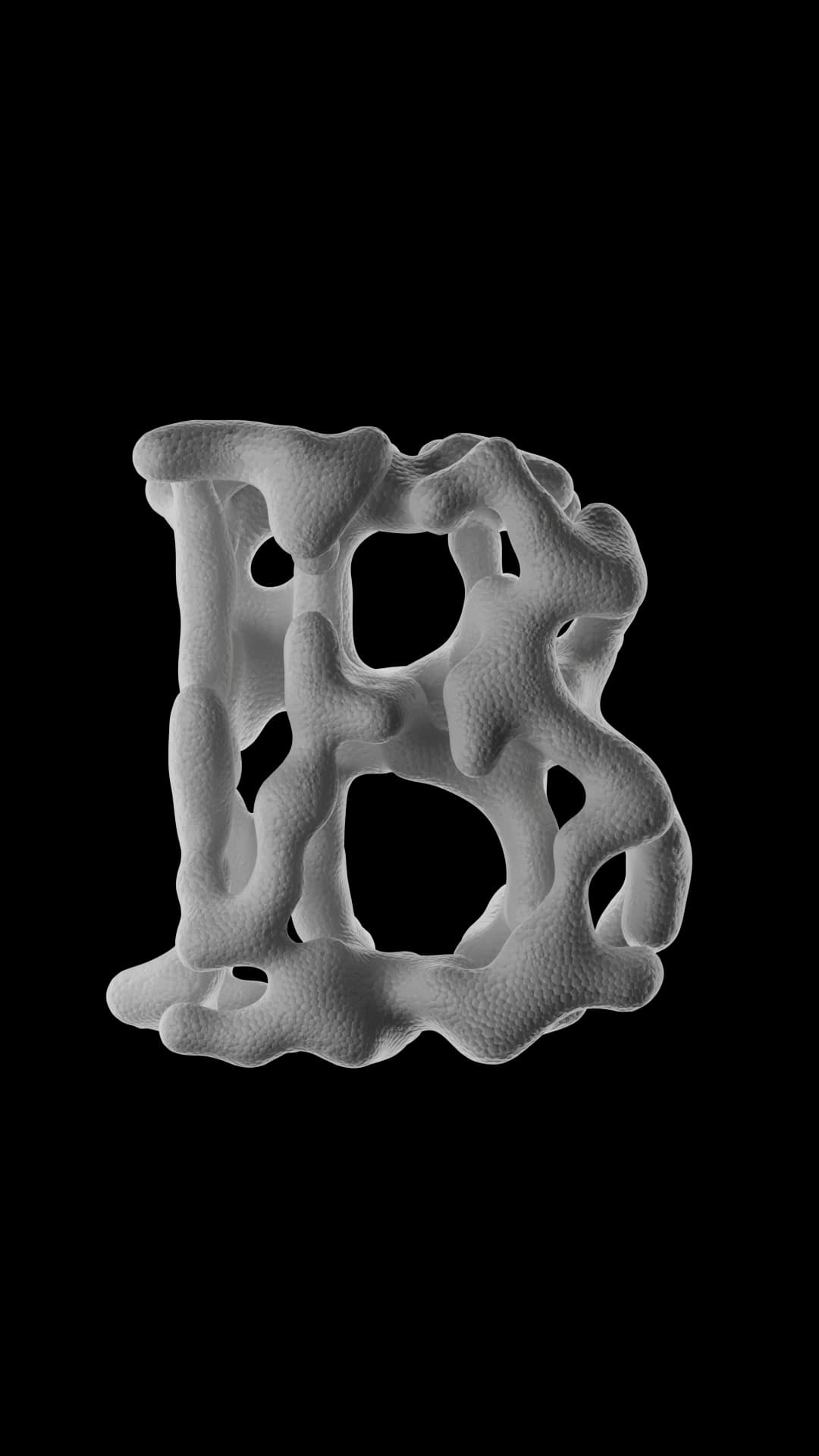
Patina Type is a 3D alphabet in patinated copper. Arial Black is the substrate: from each character's alpha, X-Particles grows matter frame by frame into a porous mass of copper with green verdigris. Growth stops at the same interval for all 36 characters, A to Z and 0 to 9: some letters hold up, others cross the limit of legibility.
Visuals


Experiment
01Formal reference
Arial Black, capitals and digits: one of Microsoft's Core fonts for the Web (1996), the most anonymous typeface on the screen, used as a neutral substrate.
Concept
How much matter can a letter accumulate before it stops being legible? Hypothesis: the limit of legibility depends on the structure of the character, not on the amount of matter. Patina is time: the letter grows, is perforated and is coated like exposed metal. It is the opposite of Growth Type: there, colonisation happens inside the scaffold and the letter resists; here, matter is born from the letter's alpha and carries it to the limit of legibility.
System
Each Arial Black character becomes an alpha texture that drives particle emission in X-Particles: points appear where the alpha is white and accumulate frame by frame. An OpenVDB mesher turns the particles into a continuous isosurface. The patinated copper material is built in Redshift with a Material Blender: layers of corroded metal mixed with Maxon Noise and dirt and ambient-occlusion maps, so bare copper shows through patches of green verdigris. Same system, same parameters and same lighting for all 36 characters: only the alpha changes.
Process
Alpha of each character (Arial Black) → particle emission from the alpha in X-Particles → frame-by-frame growth → OpenVDB meshing → patinated copper material → Redshift render with ACES colour management → frame selection within the 10–14 interval → single grade → specimen A–Z, 0–9.
Constants
Variables
Output
Specimen A–Z, 0–9: 36 individual renders, square format.